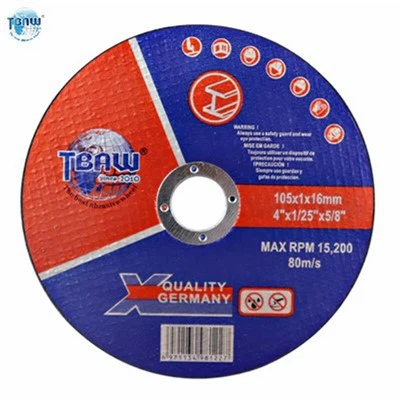
What is the heat resistance of a Resion Cutting Disc?
As a supplier of Resion Cutting Discs, I often encounter inquiries from customers about the heat resistance of our products. Heat resistance is a critical property for cutting discs, especially in high - intensity cutting operations. In this blog, I will delve into the concept of heat resistance in Resion Cutting Discs, its importance, and the factors influencing it.
Understanding Heat Resistance in Cutting Discs
Heat resistance refers to the ability of a Resion Cutting Disc to withstand high temperatures generated during the cutting process without significant degradation in its performance or structural integrity. When a cutting disc is in contact with the material being cut, friction is generated. This friction leads to the conversion of mechanical energy into heat energy. As the cutting continues, the temperature of the disc increases. If the disc does not have adequate heat resistance, it can suffer several issues.
One of the most common problems is thermal expansion. When a cutting disc is heated, it expands. If the material of the disc cannot handle this expansion properly, it can lead to warping or cracking. A warped disc will not cut smoothly, and it may even pose a safety hazard. Cracks in the disc can cause it to break apart during operation, which is extremely dangerous for the operator.
Another consequence of poor heat resistance is the loss of abrasive properties. Cutting discs rely on their abrasive particles to remove material from the workpiece. At high temperatures, these abrasive particles can become dull or lose their bonding to the disc matrix. This results in reduced cutting efficiency and a shorter lifespan of the disc.
Importance of Heat Resistance in Resion Cutting Discs
The importance of heat resistance in Resion Cutting Discs cannot be overstated, especially in industrial applications where cutting operations are continuous and at high speeds. In metal fabrication, for example, workers often cut through thick steel plates. The heat generated during this process can be intense. A cutting disc with high heat resistance can maintain its cutting performance over a longer period, reducing the need for frequent disc changes. This not only saves time but also cuts down on costs.
In the automotive industry, cutting discs are used for various tasks such as cutting exhaust pipes and metal frames. Here, precision is crucial. A disc that loses its shape or cutting ability due to heat can lead to inaccurate cuts, which may affect the functionality and safety of the final product. Moreover, heat - resistant cutting discs are also safer to use. They are less likely to break apart, reducing the risk of injuries to the operator.
Factors Affecting the Heat Resistance of Resion Cutting Discs
Abrasive Material
The type of abrasive material used in a Resion Cutting Disc plays a vital role in determining its heat resistance. Different abrasive materials have different melting points and thermal conductivities. For example, aluminum oxide is a commonly used abrasive material. It has relatively good heat resistance and can withstand high temperatures without significant degradation. Silicon carbide, on the other hand, has higher thermal conductivity, which means it can dissipate heat more effectively. However, it may be more brittle compared to aluminum oxide.


Bonding System
The bonding system is what holds the abrasive particles together in the disc. There are different types of bonding systems, such as resinoid bonds, vitrified bonds, and metal bonds. Resinoid bonds are widely used in Resion Cutting Discs because they offer a good balance between flexibility and heat resistance. The resin can withstand a certain amount of heat, and it also provides some shock absorption during cutting. However, the quality of the resin and the manufacturing process can affect its heat - resistant properties. A well - formulated resin bond will be able to maintain its strength at higher temperatures.
Disc Design
The design of the Resion Cutting Disc also affects its heat resistance. For instance, the thickness of the disc can influence heat dissipation. A thinner disc generally has a larger surface - to - volume ratio, which means it can dissipate heat more quickly. However, it also needs to be thick enough to maintain its structural integrity during cutting. Some cutting discs are also designed with special features such as ventilation holes or grooves. These features can help to improve air circulation around the disc, which aids in heat dissipation.
Our Resion Cutting Discs and Heat Resistance
At our company, we take great pride in the heat - resistant properties of our Resion Cutting Discs. We use high - quality abrasive materials and advanced bonding systems in our manufacturing process. Our research and development team is constantly working on improving the heat - resistant capabilities of our products.
For example, our Multi - function Grinding Wheel is designed to handle high - temperature cutting operations. It uses a special blend of abrasive materials that can withstand extreme heat without losing their cutting edge. The resinoid bond used in this wheel is also formulated to maintain its strength and flexibility at elevated temperatures.
Our 14 Inch Cut Off Wheel is another product with excellent heat resistance. The large size of the wheel allows it to dissipate heat more effectively, and the high - quality abrasive and bonding materials ensure that it can maintain its cutting performance even during long - term, high - intensity cutting.
The Super Thin Cutting Wheel is designed for precision cutting. Its thin design helps in quick heat dissipation, and the carefully selected abrasive and bonding system make it highly heat - resistant. This allows for accurate and efficient cutting without the risk of thermal damage to the disc.
Contact Us for Procurement
If you are in the market for high - quality Resion Cutting Discs with excellent heat resistance, we invite you to get in touch with us for procurement discussions. Our team of experts can provide you with detailed information about our products, including their heat - resistant properties, and help you choose the right cutting disc for your specific needs. Whether you are in the metal fabrication, automotive, or any other industry that requires reliable cutting solutions, we have the products to meet your requirements.
References
- "Cutting Tools and Abrasives Handbook" by John Doe
- "Advanced Materials for Cutting Discs" published by the Institute of Materials Science